01/14/2026

14/01/2026
January 14, 2026
15/01/2026
January 15, 2026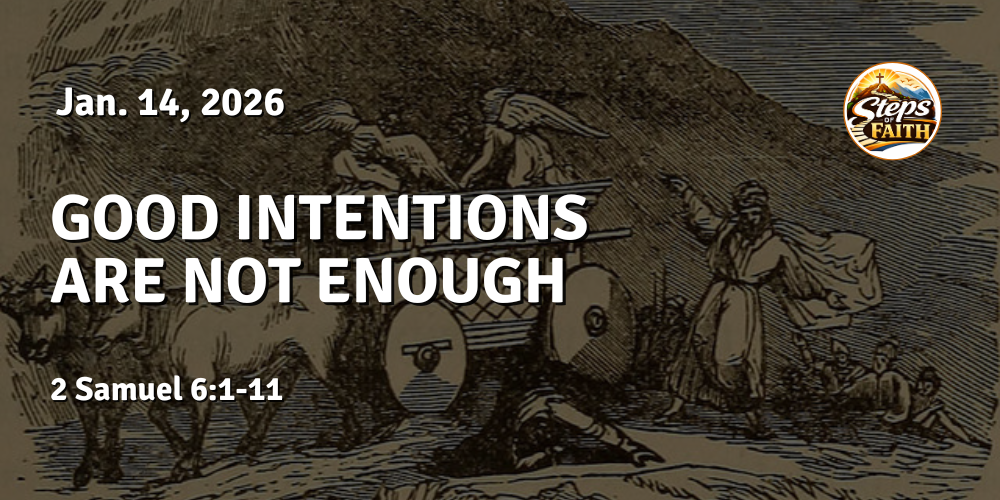
Wednesday | January 14
GOOD INTENTIONS ARE NOT ENOUGH
Base Text: 2 Samuel 6:1-11
“Why do you call Me, ‘Lord, Lord,’ and do not do what I say?” (Luke 6:46)
One of the most common phrases of our time is: “What matters is the intention.” We often use good intentions as a justification for mistakes, failures, and wrong choices. In human relationships, this logic sometimes works. But the real question is: does it work with God?
The story of David and Uzzah confronts us precisely at this point. Both had the same desire: to honor God. There was no declared rebellion, no conscious contempt, no intention to dishonor the Lord’s name. On the contrary, there was enthusiasm, joy, music, celebration, and a sincere desire to do something great for God.
David, newly established as king, decided to bring the Ark of the Covenant to Jerusalem. His desire was noble. He wanted to place at the center of the kingdom that which represented the presence of God. The plan seemed perfect: a new cart, strong oxen, celebration, praise, and a large procession. Everything appeared worthy of the Lord. Yet there was a serious problem: the method chosen was not God’s method.
The Word of the Lord was clear. The Ark was not to be transported on a cart, but carried on the shoulders of the Levites, using the poles made specifically for that purpose. Moreover, it was not to be touched. David ignored these instructions — not out of malice, but out of presumption. He assumed that his way was more honorable, more modern, and perhaps more practical.
Uzzah enters the scene at this point. When the oxen stumble, he reacts instinctively. He reaches out to steady the Ark, trying to prevent it from falling. From a human perspective, his action seems reasonable. Who wouldn’t do the same? Yet Uzzah touched what God had clearly said must not be touched. And in that moment, the Lord struck him dead.
This episode often causes discomfort. Many ask, “Wasn’t this excessive? Where is God’s love?” The answer lies in God’s holiness. God was not punishing a lack of good intention, but disobedience. The issue was not the heart’s sincerity, but negligence toward God’s Word. God cannot be worshiped in just any way, even when the motivation appears sincere.
The great lesson is this: sincerity does not replace obedience. It is possible to love God and still disobey Him. It is possible to have zeal and yet ignore His will. Zeal without knowledge can be dangerous. We can serve, sing, lead, plan, and even sacrifice — but if we disregard the Word of God, everything becomes empty before Him. The Lord does not reject a broken heart, but neither does He approve worship that dismisses His truth.
God does not adjust Himself to our good intentions; we must align ourselves with His revealed will. Worship that pleases the Lord is not born merely out of enthusiasm, but out of obedience. David learned this lesson painfully. Later, when he attempted again to bring the Ark, he followed the instructions of the Word of the Lord — and then God was pleased.
Before asking whether our intentions are good, we must ask whether our ways are aligned with the Word of God. It is not enough to want to please the Lord; we must do so in the way He has established. Examine your life, your service, your worship, and your decisions. Ask less, “What do I think is right?” and more, “What has God already revealed in His Word?” Obedience remains the safest path to pleasing God.
It is not enough to want to please the Lord;
we must do so in the way He has established.
Calvary Baptist Church of Flemington, NJ
Written by Eliakim Aquino