01/05/2026
05/01/2026
January 5, 2026
06/01/2026
January 6, 2026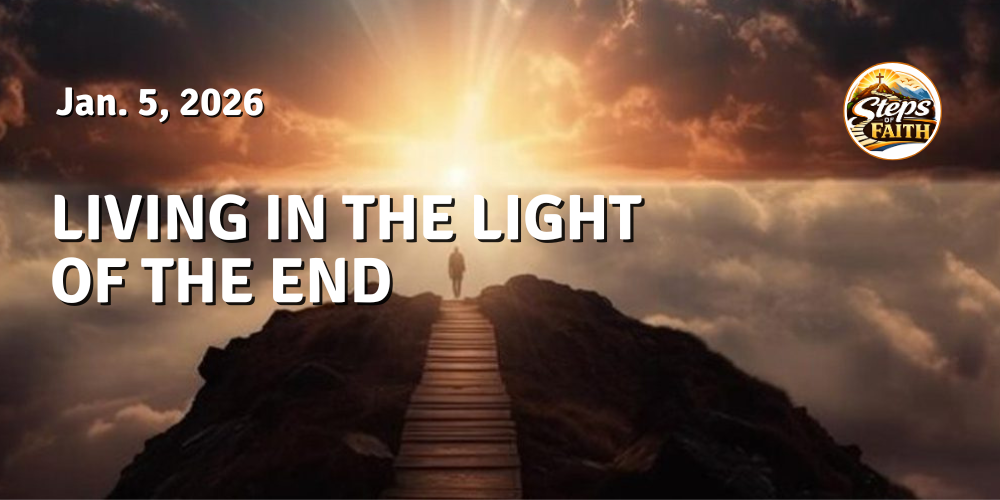
Monday | January 5
LIVING IN THE LIGHT OF THE END
Base Text: 2 Peter 3
“Since everything will be destroyed in this way, what kind of people ought you to be? You ought to live holy and godly lives.” (2 Peter 3:11)
In his second letter, Peter invites us to look at history and the future through the eyes of eternity. He reminds us that there have always been people who mocked God’s promises, questioning the return of Christ and living as if nothing were going to happen: “Where is this ‘coming’ he promised?” (v. 4). To them, time seems to deny God’s Word, and God’s patience is interpreted as weakness or forgetfulness. But Peter warns us that God does not measure time as we do; the apparent “delay” is actually an expression of mercy. He wants everyone to have the opportunity to repent and return to Him.
The apostle points to the past to teach us about the future. Just as God destroyed the ancient world by the flood, He will also bring an end to everything in this world that does not reflect His holiness. The Day of the Lord will come like a purifying fire, and everything that is temporary and earthly will be shaken. This is not meant to terrify us, but to awaken us to live differently.
Chapter 3 is not only about judgment or the “end of the world,” but about how we should live today, knowing that there is a promise of eternity. In light of this certainty, Peter asks us a direct question: what kind of people ought we to be? The answer is clear: people who live in holiness and godliness, who seek to align every thought, word, and action with God’s will. Our faith should not be merely theoretical, but practical and visible moment by moment.
Living in the light of eternity means adjusting our priorities. It is realizing that nothing in this world is permanent—neither wealth, nor status, nor fleeting pleasures. The Bible calls us to invest in what lasts: relationships, character, serving others, and above all, our communion with God.
We should examine our lives in light of Christ’s return: which habits need to change? Which relationships need forgiveness or reconciliation? How can we make our faith visible through our actions?
This perspective transforms daily life. Instead of living driven by immediacy, we are called to live with hope and intention. Every action, no matter how small it may seem, becomes a testimony of eternity. At the same time, God’s patience reminds us to extend grace to others—and to ourselves.
Living in the light of eternity is an active, not passive, life: pursuing holiness, practicing good, loving sacrificially, and holding on to hope even when the world seems delayed or unjust. It is being faithful now, while we wait for the fulfillment of God’s promises.
Those who live in the light of eternity turn every day into an opportunity to reflect Christ.
Calvary Baptist Church of Flemington, NJ
Written by Eliakim Aquino